




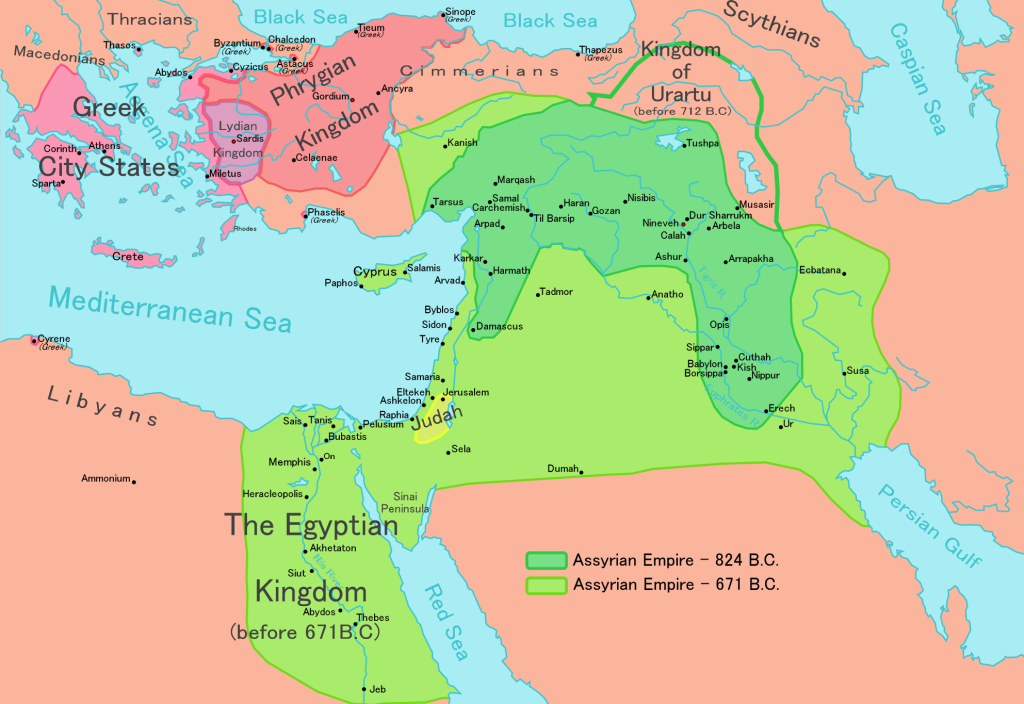
E3.1 The Expanding Neo-Assyrian Empire
- The Neo-Assyrian Empire, from east of the Tigris (parts of present-day Turkey, Syria, Iran and Iraq), restored their control of northern Mesopotamia in the 9th century BCE and followed that by expanding aggressively to the west and south during the 8th century BCE
- Tiglath-Pileser III took the throne in 745 BCE. He most likely usurped the throne with his claims of divine support from the national Assyrian god, Ashur. He was one of the most prominent Assyrians kings, who succeeded in doubling the territory of his empire
- His army marched through the Levant to Egypt and turned the Kingdom of Judea into a vassal in 734 BCE (in yellow on the map above). This involved accepting his authority and paying tributes to him. He also turned other kingdoms in the area, like Edom, Ammon and Moab into his vassals, which provided a buffer between Egypt (his main rival) and Israel and Aram-Damascus (his target)
- In 732 BCE he conquered Damascus and Galilee (northern part of the Kingdom of Israel)
- In 729 he conquered Babylon and took the title King of Babylon, as well as King of Assyria
- In 727 BCE he was succeeded by his son, Shalmaneser V, who conquered, annexed and ended the Kingdom of Israel. Its capital (Samaria) fell to the Assyrians in 722 BCE during the reign of Hoshea, the lask King of Israel
- The rivalry between the Empires of Assyria and Babylonia continued, with a revolt under Marduk in the Babylonian Empire. Circa 700 BCE King Sennacherib moved the Assyrian capital to Nineveh and in 689 reconquered and destroyed Babylon (capital of the Babylonians)
- In 671 BCE the Assyrian King Esarhaddon (one of Sennacherib’s sons) even conquered the mighty Egyptian Kingdom to expand the Assyrian Empire to its peak. It came to an end a mere 66 years later
- Sources: [8a] [8b] [8c] [20] [21] [22] [23]


E3.2 Revisiting the Kingdom of Judea and looking at its Final Fall
- From Episode 2 we are aware of key facts which are vital to understand the end of the Kingdom of Judea and the stories about that:
- There was rivalry between the Kingdoms of Israel and Judea. This rivalry led to several wars between them, for example under the Judean kings Abigam (914-911 BCE), Amaziah (798-769 BCE) and Ahaz (743-727 BCE)
- The Israelites in both kingdoms were polytheists who went through centuries of development to finally arrive at monotheism. By the fall of Judea monotheism has not won the battle yet
- The Bible stories about these 2 kingdoms:
- Originated in Judea and displayed a clear bias against the bigger and more successful northern kingdom
- Were written during the 6th and 7th centuries, in retrospect (centuries after many of the events they described)
- Had a big religious agenda to establish the cult of Yahweh as the predominant religion and promote Judea
- With this context, we’re now starting to look at the period and the kingdom where these stories originated. We have to look at 4 of the Judean kings to get a more clear picture. Please keep in mind that dates are only approximate
- King Ahaz
- Ahaz was a successful king who reigned for 16 years (around 743 – 727 BCE)
- When he was attacked by the Kingdom of Israel, he appealled to the Assyrians for help and Tiglathpileser III then turned Judea into an Assyrian vassal state in 734 BCE
- Ahaz was a loyal vassal king and paid his tributes to Assyria
- This was a fairly peaceful and prosperous time in Judea under Assyrian protection
- However, Ahaz is judged harshly by the Bible stories for polytheism
- With the fall of the Northern Kingdom of Israel in 722 BCE there is evidence that some of them migrated south to Judea, and that this migration played a role in the rise of Yahweh among the other gods of Israel. It also increased the Judean population
- King Hezekiah
- He was the King of Judea from around 727 – 698 BCE and instituted many religious reforms
- He also revolted against Assyria, and refused to pay his required tributes
- Sennacherib, King of Assyria, invaded Judea around 700 BCE
- Judea then resumed paying their required tribute, but the size and prosperity of the small kingdom decreased substantially
- The Bible stories portray him in a very positive light, but despite Hezekiah’s “righteousness” and worshipping of the right god (Yahweh), the Assyrian army devasted large parts of the kingdom (including 46 towns), took part of the agricultural land and heavy tributes. However, they did not destroy Jerusalem
- The Bible stories focused on the “deliverance” of Jerusalem by Yahweh (instead of the 46 towns which were destroyed and the submission to Assyria)
- As an aside, during this time the first signs of Arabic inscriptions appear in the archeological record
- King Manassah
- Manassah’s son, who reigned for 56 years (698 – 642 BCE)
- A pragmatic king who oversaw development and prosperity
- He cooperated with Assyria and integrated the Judean economy with the Assyrian economy
- He is judged very harshly in the Bible, as the most wicked and sinful king
- King Josiah
- In the Bible stories from Judea, King Josiah was described as the “most righteous” who executed significant reforms to establish Yahwism as the official religion of Judea. This also involved big expectations that he would lead Judea to greatness under Yahweh’s protection. So his story is an important one to scrutinize
- There are differences of opinion among historians about the events of 610 and 609 BCE. It was a time when the Assyrian Empire was on the decline, with the Babylonian Empire on the rise, Egypt starting to re-assert themselves again and shifting alliances. The evidence is not clear enough to reconstruct the exact state of affairs
- What is clear is that in 609 BCE the Egyptian army marched through Judea and Pharoah Necho II met with King Josiah at Megiddo
- The most likely reconstruction is that Necho II (who succeeded his father as King of Egypt the previous year), already expanded his area, took over Judea as vassal from the declining Assyrian Empire and summoned King Josiah to Megiddo to reconfirm his loyalty to the new Pharoah. It’s not clear what happened at Megiddo, but Necho II seemed to have executed Josiah on the spot. This version is more or less in line with the cryptic version found in 2 Kings 23
- The other interpretation is that Necho II marched through Judea to come to the aid of Assyria against Babylonia and that Josiah refused him passage, met the Egyption army at Megiddo and was killed in battle which was a crushing defeat for Judea. It then became a vassal of Egypt. This is more in line with the short battle story in 2 Chronicles 35
- The Egyptian Army was so far superior that it is regarded as highly unlikely that Josiah would have gone into full battle with them, especially in person
- The 2 Chronicle version of the story is probably a baised one, portraying Judea and Josiah in a better light (like all of their stories)
- Either way, this was an unexpected and crushing development in Judea, which only got worse from then on
- There is a fairly clear pattern visible with these 4 kings, which I’ll elaborate on in the Critical Insights at the end of this episode
- The Babylonian Empire continued to rise and in 605 BCE Nebuchadneser II defeated the Egyptians (fighting alongside the Assyrians) at Carchemish. Judea then became a Babylonian vassal until their destruction in 587 BCE
- Judea was a troublesome vassal, which continued to form an alliance with Egypt against the Babylonians
- Nebuchadneser II took military action against them and in 597 BCE replaced their vassal king (a grandson of Josiah), with his uncle Zedekiah (a son of Josiah)
- Zedekiah also conspired against Babylon, so Nebuchadneser II completely destroyed their kingdom 587/586 BCE, put Zedekiah (the last Judean king) in a Babylonian jail and killed all his children
- The stories did not quite play out as written or expected, partly because Judea neither had the military strength nor the political influence, but also because the Judean kings played the diplomatic game quite poorly
- Judea was a small, under-developed and insignificant kingdom in the region, which was a vassal state of all 3 the big empires of the time from 734 – 587 BCE, when they were finally destroyed by the Babylonians. Just as the Bible downplays the influence and achievements of the Kingdom of Israel, it exaggerates the significance of Judea for religious reasons.

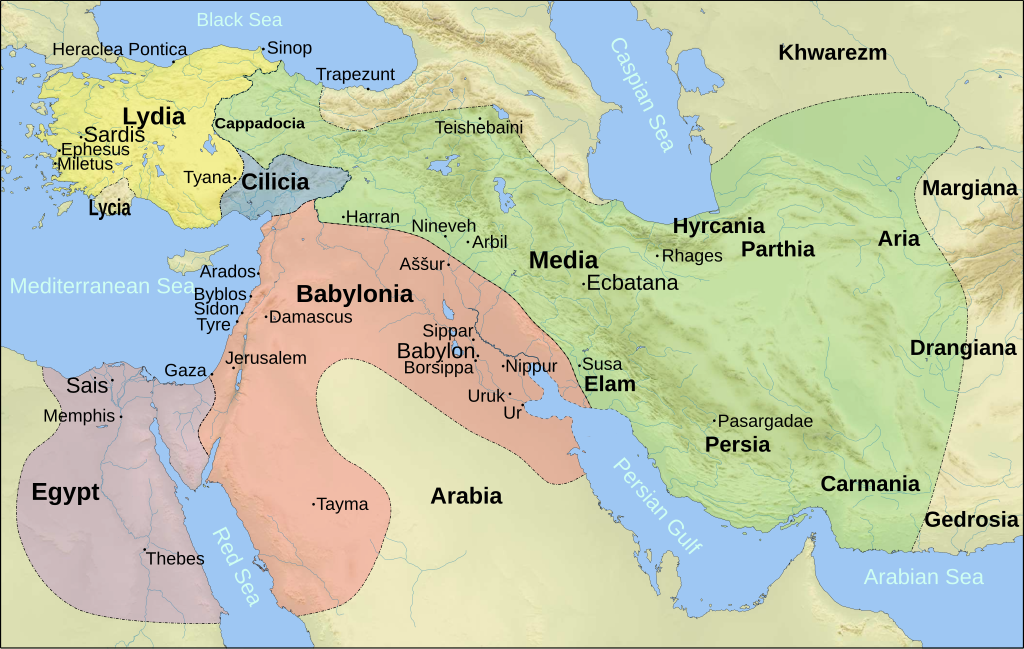
E3.3 The Neo-Babylonian Empire
- The Assyrian Empire collapsed quite swiftly after the Babylonians conquered its capital (Nineveh) in 612 BCE
- After Nebuchadneser defeated the Assyrians and the Egyptians in 605 BCA at Carchemish, they took over Judea as a vassal state (a vassal state which continued to conspire against them with the Egyptians). This was also the effective end of the formidable Neo-Assyrian Empire
- The Babylonians under Nebuchadnezzar II then conquered Judea under King Zedekiah (a vassal ruler they appointed), and in 587 BCE destroyed the temple in Jerusalem and ended the Kingdom of Judea too
- About 20-25% of the population was taking into exile in Babylon, and some of them fled to Egypt, but life continued in Judea under Babylonian rule
- Much of the apocalyptic imagery we find in the Bible reflect the conditions, architecture and statues of Babylon at the time of the exile
- Monotheism emerged from the Babylonian exile and after the return from exile (see E2.4.3 above for details)
- With the conquest of Judea, both the Israelite Kingdoms, which originated around the 9th or 10th century BCE came to a final end in 587 BCE
- Sources: [8d] [24] [25]

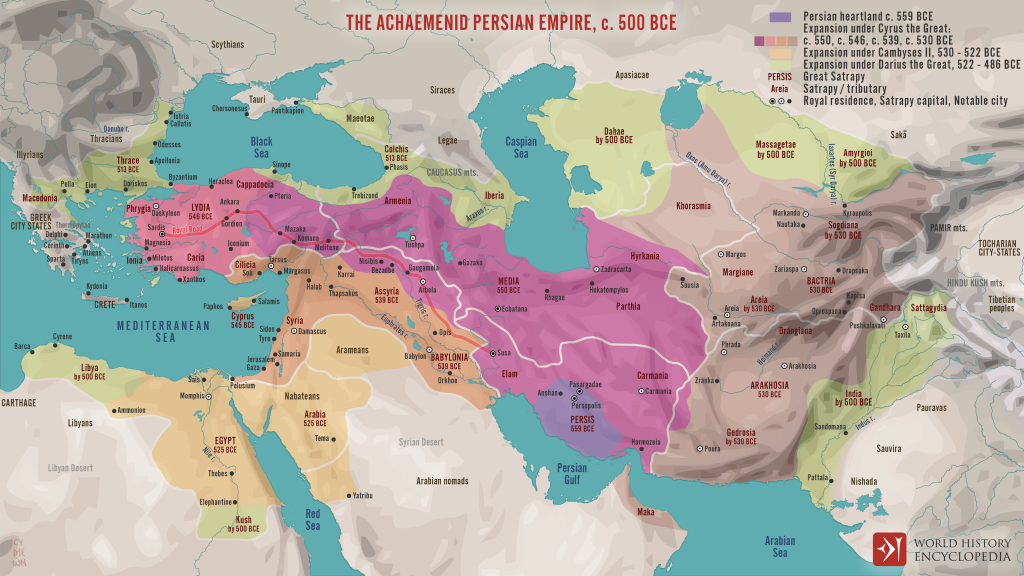
E3.4 The Persian Empire
- By 539 BCE the Persian Empire (also known as the Achaemenid Empire) under Cyrus II (Cyrus the Great) conquered Babylon and with that Palestine
- Cyrus allowed Judeans exiled by Babylonia to return and live in a self-governing province under Persian rule, but indications are that the majority stayed in Babylon and with time formed other communities
- This province was called Yehud (a smaller area as the Kingdom of Judea) and the Judeans became known as Yehuds (Jews). The term Judaism seems to be from this period too (the religion of the Yehuds)
- Indications are that Zoroastrianism possibly became the official Persian religion as early as under Darius the Great, who ruled 533 BCE – 485/486 BCE or no later than under Xerxes I (Persian king from 486 – 465 BCE). It retained this status, with varying levels of political influence almost uninterruptedly until the Muslim conquests of the 7th century
- With many exiles from Judea still living in Persia then, after they elected not to return to Palestine, and with the Persian ruling Judea, it seems likely that the world’s oldest monotheism could possibly have had an influence on the emerging Yahwism, with the similarity of dualistic concepts as potential evidence
- The Persians rebuilt the destroyed temple in Jerusalem, which was completed in 516 BCE. This was also the start of Second Temple Judaism, which was largely monotheistic, with some remnants of polytheism.
- The synagogue originated here, as well as the Babylonian Talmud, so the Jewish community in Persia had a significant impact on Judaism
- The lingua franca of Palestine became Aramaic (a semitic language from neighbouring Aram, closely related to Arabic), while Hebrew remained the language of the upper class in Judea, until it was replaced by Greek (see E3.5 below)
- Sources: [8d] [26] [27] [27b] [27c]

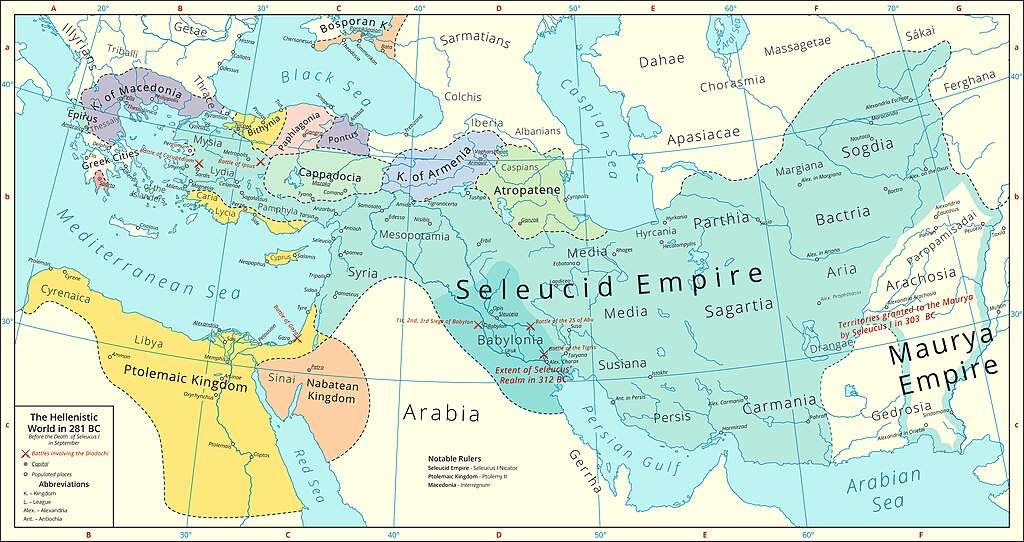
E3.5 The Greek Empire
- There was longstanding military conflict between Greece and Persia, going back to the Greco-Persian wars which started in 499 BCE
- Alexander the Great, King of Macedonia, established the Greek (or Macedonian) Empire in the 4th century BCE
- In 332 BCE he conquered the Persian Empire under Darius III and he conquered Persian-controlled Egypt. With that he gained control of Palestine
- A process of widespread Hellenization, including the spread of the Greek language especially among the upper classes, was a result of the vast Greek Empire of Alexander
- This Hellenization played a major role in the spread of Judaism from about 150 – BCE to 70 CE, as the Greek Empire was accessible and influential, with Judaism spreading within it
- Alexander died young in Babylon in 323 BCE, which led to power struggles and the division of his empire
- One of his generals (Ptolemy) became the ruler of Egypt in 323 BCE and later crowned himself Pharoah of Egypt in 305 BCE. This southern part of the Greek Empire became known as the Ptolemic Kingdom, based in present-day Egypt
- One of his other generals (Seleucus) managed to gain control of Babylon and most of the northern empire in 312 BCE. It became known as the Seleucid Empire
- The Seleucid King, Antiochus III, conquered Phoenicia and Palestine from the Ptolemic Kingdom at the Battle of Panias in 198 BCE (which is why it is still showed as part of the Ptolemic Kingdom on the 281 BCE map above)
- Greek rule became more oppressive under the Seleucid Greeks as they pursued a more agressive strategy of Hellenization. King Antiochus IV outlawed Sabbath observance in 167 BCE and dedicated the 2nd Temple to Zeus, which led to the Maccabee revolt
- Sources: [28] [29] [30] [31]
E3.6 The Hasmonean Kingdom (164 – 63 BCE)
- The Maccabees succeeded in taking Jerusalem through guerilla warfare and rededicating the Temple in 164 BCE (the reason for the Jewish holiday of Hannukah)
- This was the start of the short period when the Hasmonean Kings ruled in Palestine, which expanded their territory with the conquest of Samaria (the Northern Kingdom), parts of present-day Jordan and the Kingdom of Edom (or Idumea)
- The first evidence we have of the Pharisees and Sadducees is from the Hasmonean Kingdom, so it is possible when they originated. They functioned as political parties in the kingdom, with the Pharisees objecting to the conquest and forced conversion of neighbours
- Yonatan Adler (rabbi and Israeli Professor of Archeology) published a book in 2022 in which he showed the archeological evidence that many standard Jewish religious practices only originated during Hasmonean rule [32]
- They got rid of the last vestiges of polytheism and is the 1st Jewish Kingdom which was unquestionably and fully monotheistic. They also immediately showed the dark side of monotheism, including its intolerance:
- They started spreading Judaism by force. A pattern which would repeat with the other 2 Abrahamic monotheistic religions
- In an interesting book, published in 1999, Shaye Cohen (a rabbi, historian and Professor of Hebrew Literature and Philosophy at Harvard) made the argument that during the Hasmonean Kingdom, we witness Jewish identity transcend nationalism to primarily become a religious identity with the conquering of neighbours and converting them to Judaism. For example, in 125 BCE under the Hasmonean King John Hyrcanus, they conquered the Kingdom of Edom (or Idumea) to their south and annexed it by force, not only politically but into Judaism [33]
- The power of the Roman Republic continued to grow and their armies started to move and conquer land, even before the official start of the Roman Empire. This coincided with the decline and collapse of the Seleucide Empire. In 64 BCE the Roman general, Pompey, conquered Syria [34a]
- When civil war broke out between the Hasmonean King John Hyrcanus II (supported by the Pharisees) and his brother Aristobulus (supported by the Sadducees), and they ransacked part of Phoenicia, Pompey intervened, captured Jerusalem in 63 BCE and turned the Hasmonean Kingdom into a Roman vassal state. The sitting king, John Hyrcanus II, was appointed as High Priest only, with no political power
- This was the end of the Hasmonean Dynasty and the last time there was independent Jewish rule in Palestine (until 1948), a period of 2011 years
- As an interesting aside for those who view history through the biblical lens, Herod was neither a Roman Emperor nor a Roman Governer of Palestine. He was a Jewish convert from Idumea (Edom), as part of the Hasmonean Kingdom. He was appointed by the Roman Senate to run their Palestine vassal state as “King of the Jews”
- The Hasmonean Kingdom lasted for 101 years
- Sources: [34] [35]


Left: The borders of the Hasmonean Kingdom after John Hyrcanus conquered Edom [Image credit: Wikimedia Commons, Pubic Domain]
E3.7 Palestine Episode 3 – Critical Insights
E3.7.1 INSIGHT 1 – Constant Change
- As I wrote this episode, one of the most conspicious observations for me was the enormous and non-stop change, in so many ways
- Geo-political change
- The ongoing rise, expansion and fall of empires, including the most powerful
- The constant and vast changes to political borders, as visible on all the maps provided above
- Constant change to ethnic groups. With the geographic expansion of empires, the conquerers spread their DNA far and wide on their conquests and throughout their empires. Episodes 4 and 6 will shine a spotlight on changing ethnicity
- Change in language and culture. New empires also spread their language and cultural customs, with subjects often learning this new language and it sometimes becoming their primary language after a few generations
- The rise and fall of religions and their gods, with some surviving and others not. The survival of religions seems to be linked to
- Military and political power (see Episode 4 and 5)
- The power of their narratives and how well it resonate with people
- Quite often (but not always), political power can vastly enhance the influence of religious narratives
- This is especially relevant for people reading this ancient history today with the mindset of fixed nation-state borders, which in many cases are not even 100 years old
- If you view the world as consisting of fixed states, and especially static ethnic groups and static religions, you owe it to yourself to follow this series.
E3.7.2 INSIGHT 2 – Violence and Tribalism
- Another striking observation about human history is the constant theme of political violence, war and conquest. That also strikes me everywhere I travel when I invariably explore the local history, and it certainly struck me when researching and writing this series, from Epsiode 2 all the way through to Episode 17, from the Bronze Age to the present
- Violence played a major role in shifting political borders, as well as ethnic, religious and cultural changes
- I cannot attempt an in-depth explanation of the human propensity for political violence (let alone aggression and violence in general), but I want to make a few observations
- Human nature clearly plays a role in this propensity for violence
- More specifically, tribalism is a deep-seated result of evolution: around 300,000 – 320,000 years of surviving by trusting your clan and being suspicious of “the others”
- Some interesting sources in this regard:
- “The Evolution of Tribalism: A Social-Ecological Model of Cooperation and Inter-Group Conflict Under Pastoralism” by Nicholas Seltzer [54]
- “Tribalism in War and Peace: The Nature and Evolution of Ideological Epistemology and Its Significance for Modern Social Science” by Cory Clark and Bo Winegard [55]
- “The Special Power of Tribalism” by Richard Wrangham, Professor of Biological Anthropology at Harvard University [56]. This is a video lecture on Youtube
- As a result, tribal or xenophobic narratives tend to resonate very well with people, regardless of whether it is constructive, necessary or counter-productive in a highly connected, integrated, urbanized and cosmopolitan world. The evolutionary process functions much too slow for human beings to adjust to these fundamental, and quite recent, social and political changes of the last century or so
- Religion and Tribalism:
- Religious stories can be quite tribal, like we’ve seen with Christian Nationalism. This can quite happily co-exist with inclusive stories within the same religion, as incoherence is quite common in bigger narratives
- Religion is also quite effective in mobilizing large numbers of people for political agendas, as was proven by Adolf Hitler, Slobodan Milošević, Saddam Hussein and Donald Trump.
‘Human nature clearly plays a role in this propensity for violence… More specifically, tribalism is a deep-seated result of evolution: around 300,000 – 320,000 years of surviving by trusting your clan and being suspicious of “the others”… As a result, tribal or xenophobic narratives tend to resonate very well with people, regardless of whether it is constructive, necessary or counter-productive in a highly connected, integrated, urbanized and cosmopolitan world‘


E3.7.3 INSIGHT 3 – The Dark side of Monotheism
- The first two monotheisms with political power (Zoroastrianism and then Judaism) started to show us the dark side of monotheism
- Although the general perception is that Zoroastrianism was less violent than the other monotheisms, this is not quite borne out by the historical record:
- From the late Bronze Age inscriptions indicate that it was often used as religious justification for war
- There are several inscriptions showing Darius the Great claiming his victories in the name of Ahura Mazda
- With the Hasmonean Kingdom (164 BCE to 63 BCE) monotheism in Judea developed into a strict and official monotheism, which also gave the world its second encounter with monotheism having political power (monotheistic Judaism). Its intolerance and forcing its religion on others with the limited political power it had (like on the Kingdom of Edom), was not a positive development.
‘It is this entity [Ancient Israel], rather than the imperial powers of Egypt, Assyria, Babylonia, Persia, Greece and Rome, which, in our standard ‘biblical histories’, comes to dominate the history of the region‘ – Keith Whitelam
E3.7.4 INSIGHT 4 – The Myopia of the West
- Major empires ruled and dominated the Mediterranean and surrounds for millenia
- From the Akkadian, Hittite and Egyptian Empires during the Bronze Age (Episode 2)
- To the Assyrians, Babylonians and Persians during the Iron Age (Episode 3)
- Leading to the Greek, Roman, Byzantine and Ottoman Empires (Episode 3 – 5)
- Writing critically about the blatant bias of biblical historians in the West Keith Whitelam made the following interesting points:
- “It is this entity [Ancient Israel], rather than the imperial powers of Egypt, Assyria, Babylonia, Persia, Greece and Rome, which, in our standard ‘biblical histories’, comes to dominate the history of the region” [49]
- He also points out that biblical scholarship “in its all-consuming search for Ancient Israel, has reflected the myopia of the West” and “remained blind to the indigenous populations” [50]
- “The tiny province of Yehud has been allowed to monopolize and dominate discussions of the period. It is a period desperately in need of reassessment in order to free Palestinian history from the tyranny of the discourse of biblical studies” [51]
- A growing number of scholars from different disciplines helped turn the tide to break the influence of the biblical narrative on history and archeology. Two examples:
- Giovanni Garbini, who described biblical studies as mere paraphrases of the biblical text due to theological motivations in “History and Ideology in Ancient Israel” [57]
- P.R. Davies in his “In Search of ‘Ancient Israel’ “[58]
- It is indeed puzzling that the “tiny province of Yehud” monopolized the historical research and discourse in the West
- Not only because these world Empires were politically and militarily vastly superior, dominated the region and its history, and subjugated and destroyed the Israelite kingdoms
- But also because all of the significant Bronze and Iron Age developments, which made it the Cradle of Civilization, came from these empires. The Assyrian, Babylonian and Egyptian Empires all left vast cultural, political and technological legacies
- Including the “covenant” found in the Bible which was based on the Assyrian vassal treaties, with which the Judeans were highly familiar exactly when they created these L1 stories
- The Kingdom of Judea, which only existed for about 400-500 years (and for the last 150 year or so of their existence were a vassal state of the Assyrians, the Egyptians and the Babylonians)
- Did not have any major political achievements or legacy
- Was pretty inept at navigating the diplomacy between the major empires of the time, which led to their destruction
- Did not introduce the world to monotheism as is popularly claimed and believed
- Has as its main achievement the retrospective biblical story of a Chosen People and their Promised Land, which for some reason resonated better than the bigger achievements of the Northern Kingdom and especially the much bigger power and achievements of the great Empires of the day or any accurate historical record keeping of the time, of which there was plenty.
E3.7.5 INSIGHT 5 – Significant Historical Challenges to the L1 Narrative


- Let’s continue to critically assess the historical record in the harsh light of day
- The core of the Israelites L1 narrative (that they had a god who favoured and protected them) was not unique at all
- It applied to all the nations around them, like Ashur who was the national god of Assyria
- They also took over gods from the Canaanite pantheon (including Yahweh) as they started to construct their own Layer 1 narrative
- We know from Episode 2 that the Israelites did not conquer Canaan on a grand scale, they gradually emerged from within
- We know from Episode 3 that when they finally created two kingdoms
- These kingdoms were short-lived
- The Kingdom of Judea was tiny and insignificant among the major empires of the world at the time and they were destroyed by these much bigger and more powerful empires of the time (who all worshipped other gods)
- They lost their “promised land” rather quickly, despite the promise, protection and the “omnipotence” of their god, Yahweh
- What’s even more significant is the fact the these L1 stories about a Chosen People and their Promised Land (with the Exodus and Conquest of Canaan, which we discussed in detail in Episode 2), only originated as little as 100 years before the final fall of Judea in 587 BCE. These stories were created by the religious elite of Judea in the 6th and 7th centuries BCE in their efforts to establish the Cult of Jahweh in Judea
- So the way these stories developed is something like the following
- At first the Israelites worshipped several Canaanite gods, among other reasons for protection during war
- They added gods for this, like the fierce warrior-god of Edom, Jahweh
- This gradually led to Jahweh becoming their predominant and national god (monolatry), with claims that he is more powerful than the gods of the neighbours
- The next step is predominant monotheism with claims that he is not only more powerful than the neighbouring god, he is the only and omnipotent god (protector of his Chosen People)
- When the other armies continued to beat them on the battlefield, completely destroyed Israel and even turned Judea (the hero of the story) into a vassal, that posed severe challenges to this fairly new story
- Good theological rationalization was at hand though, as the supporters of Jahweh could always claim that the kings of the north were not pious enough and suffered Jawheh’s punishment for their polytheism (especially since they wrote that in retrospect)
- Then the problems came much closer to home:
- With the “righteous” kings of Judea doing the religious reforms these religious elites asked for and were pious worshippers of Jahweh only
- Despite that the powerful Assyrian, Egyptian and Babylonian armies still destroyed them on the battlefield several times, killed the “most righteous” king Josiah, and eventually completely destroyed the Kingdom of Judea too
- “One thing is clear. The Deuteronomistic historian, who saw Josiah as a divinely annointed messiah destined to redeem Judah and lead it to glory was clearly at a loss to explain how such a historical catastrophe could occur and left only a curt, enigmatic reference to Josiah’s death. The dreams of this king and would-be messiah were brutally silenced at the hill of Megiddo” [40c]
- The biblical response was twofold (both excellent examples of the confirmation bias, the lifeblood of faith and religion):
- They largely ignored these negative developments
- The story about Sennacherib crushing Hezekiah’s revolt in 700 BCE focused on the “deliverance” of Jersualem by Yahweh and not on the devastation of the rest of Judea and the decisive defeat in battle
- The story about Josiah’s death gets little coverage in the Bible “In his days Pharoah Necho king of Egypt went up to the king of Assyria to the river Euphrates. King Josiah went to meet him; and Pharoah Necho slew him at Megiddo, when he saw him” (2 Kings 23:29). There is a different battle story in 2 Chronicles 35, still with very sketchy detail, while other much less significant events are elaborated on in a lot more detail
- New prophets of the Jahweh Cult came up with even more innovative theological rationalizations (like Christianity has done for centuries): It’s not that Ashur (the national god of Assyria), Sekhmet (the Egyptian warrior goddess of destruction) or Marduk (the main Babylonian god) were more powerful than Jahweh when they devastated and eventually destroyed Judea, Yahweh actually just “used” these empires!
- They largely ignored these negative developments
- As an aside, it seems to me Jahweh was a pretty vengeful god to have as a “protector”
‘It seems to me Jahweh was a pretty vengeful god to have as a “protector”…
And it’s almost as if the protection of a powerful Empire, like the Assyrians, was vastly more useful than the protection of an invisible deity‘
- Another related insight goes back to the clear pattern we saw with the 4 Judean kings discussed in E3.2 above:
- The kings harshly judged as wicked and polytheistic by the Bible (like Ahaz and Manassah) were much more pragmatic and inclusive, and had successful reigns during which Judea prospered
- The “righteous” kings supporting the Yahweh cult, were more “nationalistic” (for lack of a better term in the Iron Age) and were quick to revolt and to judge their fellow Israelites
- It seems likely that these revolts were probably at least partially the result of a religious narrative telling them that god was on their side and would give them victory
- The diplomatic prowess of these “righteous” kings were therefore quite questionable because they probably put too much faith in these religious narratives
- It also shows how strongly polytheistic Judea was until just before its final fall, and what a big power struggle existed between the pragmatic more successful kings and the Cult of Jahweh
- With the Cult of Jahweh solely judging kings and events in terms of loyalty to their preferred god, and not peace, prosperity or longevity
- It is largely the voices of the Yahweh Cult from Judea that made it into the Bible. It would have been very interesting if we had records of the narratives representing succesful kings like Manassah and Ahaz (and Omri and Ahab from the Northern Kingdom)
- History could have been very different if the other faction won the upper hand instead of the Cult of Yahweh. The Israelite Kingdoms may have survived and the resulting “holy scriptures” or narrative would have been very different.
- And it’s almost as if the protection of a powerful Empire, like the Assyrians, was vastly more useful than the protection of an invisible deity
- In retrospect, it seems unlikely that the L1 story would survive among the Judeans after 587 BCE. On the contradry, it even spread much wider than the faithful of Judaism. How did that happen, given
-
- The lack of historical basis to start with
- With the historically developments not following the narrative at all?
-
- The next few episodes (starting with Episode 4) will investigate how this story developed, how it was amplified and became so influential, despite its lack of historical basis.
‘The Confirmation Bias is a logical fallacy which involves people focusing on information that confirms their pre-existing beliefs, ignoring information that contradicts their beliefs and interpreting evidence in a way to fit their beliefs’

