



The first noteworthy Secular Thinker we cover at the launch is the British Philosopher, Logician and Mathematician, Bertrand Russell. He was selected for a variety of reasons:
- The 52nd commemoration of his death 4 weeks ago (2 Feb 1970)
- The major contributions he made to Logic and Philosophy, but also to Secularism
- The role some of his books played in my personal journey.
Brief Bio of Bertrand Arthur William Russell:
He was born in Wales on 18 May 1872 into an influential family of the British aristocracy. His paternal Grandfather (Earl Russell) was a former British Prime Minister. Russell was orphaned at the age of 3 and was mostly raised by his maternal grandmother. He studied Philosophy and Mathematics at Trinity College, Cambridge and especially focused on the foundations of Mathematics, and Logic.
He was a political activist, a pacifist and anti-imperialist. He was sentenced to six months’ imprisonment in 1918 for a pacifist article which was published in the Tribunal. One of his major works (Introduction to Mathematical Philosophy) was written from prison and published in 1919. Russell spent another 8 days in prison in 1961, at the age of 89, for attending an anti-nuclear demonstration in London.
He became the 3rd Russell Earl in 1931. He survived a plane crash in 1949, and he was married 4 times, with his 4th marriage lasting 17 years until his death in 1970, at the age of 97. He died of influenza and was cremated at a small secular ceremony, according to his wishes.
Career
Russell mostly lectured at Trinity College in Cambridge, and the London School of Economics. Alfred North Whitehead was a former teacher and friend, with whom he wrote “Principia Mathematica”. Russell was a founder of Analytical Philosophy in Britain, with a colleague (G.E. Moore) and his famous student and protégé, Ludwig Wittgenstein.
He went on a lecturing tour of the USA from 1938 to 1944, and lectured at most of their leading universities.
In 1934 he was awarded the Sylvester medal of the Royal Society, as well as the de Morgan medal of the London Mathematical Society. In 1949 he received the Order of Merit and in 1950 he was awarded the Nobel Prize for Literature, which was awarded to him in person by King George VI. [1]
Russell was openly secular, and regarded religion as harmful superstition. He participated in a number of debates on religion, like the debate with Bishop Frederick Copleston on the existence of god, broadcast by the BBC in 1949. [2] [3]
He participated in numerous BBC broadcasts and series. Until his death he was active in humanist organizations, e.g. as a member of the Advisory Council of the British Humanist Association (now Humanists, UK) and also as President of Cardiff Humanists.
“There is exactly the same degree of possibility and likelihood of the existence of the Christian God as there is of the existence of the Homeric God. I cannot prove that either the Christian God or the Homeric gods do not exist, but I do not think that their existence is an alternative that is sufficiently probable to be worth serious consideration." - Bertrand RussellRussell called himself both an Agnostic and an Atheist at different times, as he explains in this 1947 essay: “Therefore, in regard to the Olympic gods, speaking to a purely philosophical audience, I would say that I am an Agnostic. But speaking popularly, I think that all of us would say in regard to those gods that we were Atheists. In regard to the Christian God, I should, I think, take exactly the same line”. [4]
He still worked with a strict definition of “Atheism” as a position which claims the ability to prove that no god exists. This is not possible, as he indicates in this essay, and I’m not aware of anybody making that claim today or using that definition. A broader definition of “Atheism” as simply rejecting all theist claims, is much more common today and the one used by me and the CSF. There is no contradiction between us and Bertrand Russell, as some theists like to suggest.
The British Philosopher, A.C. Grayling, wrote an interesting introduction to Russell’s Philosophy for the Oxford University Press “Very Short Introduction” series: “Russell: A Very Short Introduction”.
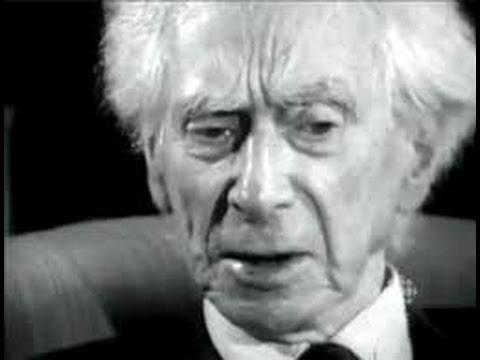
A Video Message for Future Generations
An excerpt from an interview with the BBC in 1959, just before Russell’s 87 birthday
Quotable Quotes
“There is exactly the same degree of possibility and likelihood of the existence of the Christian God as there is of the existence of the Homeric God. I cannot prove that either the Christian God or the Homeric gods do not exist, but I do not think that their existence is an alternative that is sufficiently probable to be worth serious consideration.”
“When you are studying any matter, or considering any philosophy, ask yourself only what are the facts and what is the truth that the facts bear out. Never let yourself be diverted either by what you wish to believe, or by what you think would have beneficent social effects if it were believed. But look only, and solely, at what are the facts.”
“The fact that an opinion has been widely held is no evidence whatever that it is not utterly absurd.”
“So far as I can remember, there is not one word in the Gospels in praise of intelligence.”
“The whole problem with the world is that fools and fanatics are always so certain of themselves, and wiser people so full of doubts.”
“Three passions, simple but overwhelmingly strong, have governed my life: the longing for love, the search for knowledge, and unbearable pity for the suffering of mankind.”
“Fear is the main source of superstition, and one of the main sources of cruelty. To conquer fear is the beginning of wisdom”
“Cruel men believe in a cruel god and use their belief to excuse their cruelty.”
“It has been said that man is a rational animal. All my life I have been searching for evidence which could support this.”
“Religion is something left over from the infancy of our intelligence, it will fade away as we adopt reason and science as our guidelines”
Main Publications
Bertrand Russell published more than 60 books and thousands of articles. Below is a list of some of his main works.
“The Foundations of Geometry” (1897)
“The Principles of Mathematics” (1903)“Principia Mathematica” with A.N. Whitehead (1910-1913)
“The Problems of Philosophy” (1912)
“Introduction to Mathematical Philosophy” (1919)
“An Outline of Philosophy” (1927)
“Skeptical Essays” (1928)
“A History of Western Philosophy” (1946)
Two of his popular books, which I thoroughly enjoyed:
“Why I’m not a Christian” (1927)
“The Conquest of Happiness” (1930).
Here is an Open Library link to Russell’s publications: https://openlibrary.org/authors/OL112912A/Bertrand_Russell
The next “Secular Thinkers” article:
“Thomas Jefferson” (scheduled for 13 April 2022).