



An interesting article by Peter Smith of AP News, outlining the complexity of Church relations in the Ukraine, as well as between the Ukraine, Russia and Turkey.
The link to the article itself:
In the “Latest News” category we do not do in-depth analysis, but only highlights relevant news and then make brief comments and add context on the news articles we share. Today’s observations (and these will normally be more brief):
- The prevalence of ongoing differences, splits and rivalries between churches, going back many centuries. This case, in a nutshell:
- The East-West Schism of 1,054 between the Catholic Church and the Eastern Orthodox Church
- The Eastern Orthodox Church is headed by The Ecumenical Patriarch Bartholomew I, based in Istanbul, Turkey (the old Constantinople). He is the 1st among equals; he does not have full authority over the Orthodox Church, like the Pope has over the Catholic Church
- There is rivalry between Patriarch Kirill of the Russian Orthodox Church (the biggest Orthodox Church) and Bartholomew I in Istanbul
- The split between the Orthodox Churches in Ukraine
- With the smaller one (Ukrainian Orthodox Church) still falling under the authority of Kirill
- And the bigger one (Orthodox Church of Ukraine, which is also the 2nd biggest Orthodox Church globally) recognized by Bartholomew I as an independent Church in 2018.
- In Ukraine there are 3 major parties, all largely opposing the Russian invasion: these two Orthodox Churches and the Catholic Church.
- Both the Pope in the Vatican and Ecumenical Patriarch Bartholomew I in Istanbul condemned the Ukraine invasion.
- Patriarch Kirill and the Russian Orthodox Church, on the other hand, support Putin. He did not condemn the invasion of Ukraine, he called Putin’s opponents in the Ukraine evil forces and a few years back he called Putin a miracle from god. He is on record as explicitly stating that there is a religious and cultural unity between Russia, the Ukraine and Belarus.
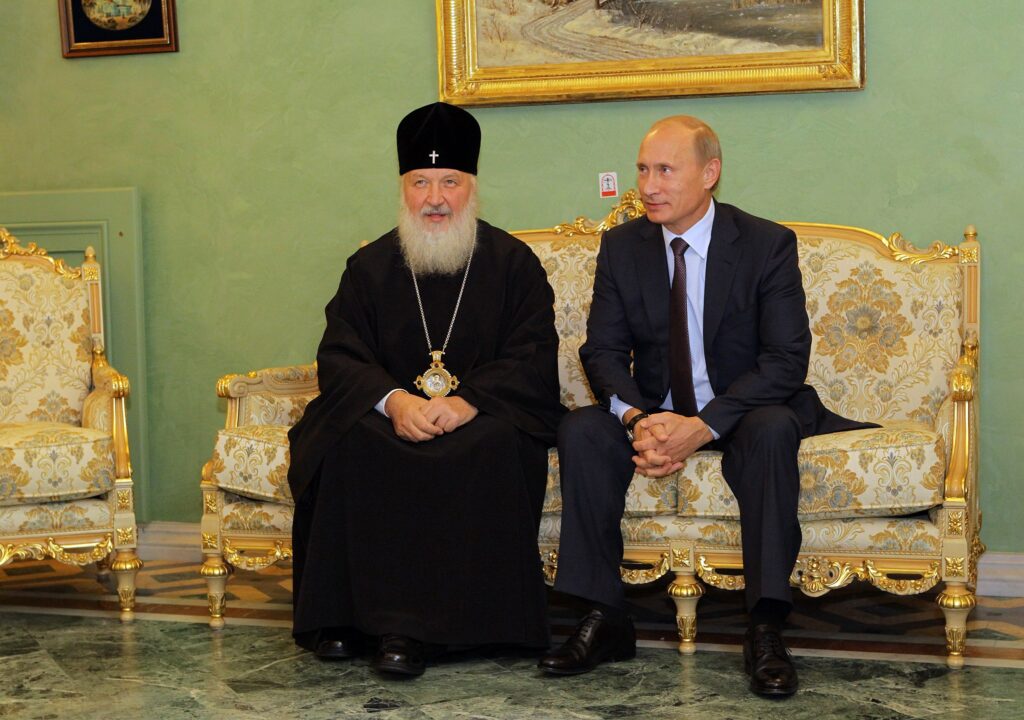
- How Putin is using religion in his strategy and rhetoric, like so many political leaders before him:
- It remains a useful tool to mobilize people
- Patriarch Kirill seems to provide him with religious rationale and legitimacy
- An interesting question if it is only a tool for Putin’s political ambition of a bigger Russian Empire, or whether he also has an ambition for a united and more influential Russian Orthodox Church.
- Is Patriarch Kirill also using Putin to enlarge his Church and his influence?
- The split between Orthodox Churches is both contributing to the war, and is also exacerbated by it
- But most of all, I find it fascinating to see the Religious Right in the US aligning themselves with the arch-conservative Orthodox Churches and conservative Catholic Churches in what seems to be an ambition for some sort of a conservative global Christendom
- Steve Bannon is quite a prominent figure in this regard
- Liberal US Christians are the enemy in this mindset (not to mention secularists in the US and the West), while the Russian Orthodox Church is seen as a critical ally
- I wonder where their support will lie in this rivalry between the 2 Orthodox Churches and Roman Catholics in the Ukraine, and the Russian Orthodox Church.
- Religion clearly plays a role in this conflict, the only question is how big this role is.